Arbitrage, Globalization, and Populism
Populism is a conspiracy—but not the one you think. Lots of academic research (mine included) and intellectual reflection has long assumed that populism is the consequence of “un-managed” globalization. While in principle globalization enlarges the “size of the pie”, if left to its own devices will produce redistributive effects not only between countries, but also within, and the “double-losers”- individuals who are worse-off in respect to their peers, within countries who are worse-off among countries- will eventually rebel. Such distributive effects are well studied by economic theory: the standard trade model, grounded in the thinking of Heckscher, Ohlin and Samuelson, predicts price convergence on a global scale and therefore a certain distribution of costs and rewards; Krugman’s own thinking on economies of scale in a global economy equally predicts a global price alignment, although on different equilibria. Hence, once we start observing the predicted phenomena- relocation of production, downward price convergence, increasingly unequal returns on factors of production, and populist backlash- it is straightforward to jump to conclusions. And certainly there is some truth in the idea that un-managed globalization is increasingly less welcome in the west: after all, many populist politicians have built rhetorically vehement anti-globalist coalitions bootstrapping their way to power; anti-globalist rhetoric has appeared in the discourses of the likes of Donald Trump, Boris Johnson, Marine Le Pen, Geert Wilders, and Bolsonaro; theory and facts, here, seem to align.
But it is that so? In this piece, I attempt to formulate an alternative to this classic view on globalization. I will argue that a certain populism emerges (or better, it is stewed so to emerge) with the goal of defending a certain view of globalization; a type of globalization that was dramatically endangered by the “third-way” approach to global multilateralism; and along with it, global multilateralism was endangering hefty payoffs for agents engaging in this type of globalization. Under this perspective, populism is – paradoxically- an élite-driven project (albeit successful in mobilizing masses); and for this reason, it sees the control of the media as absolutely essential. Under this perspective, élite-driven populism is inherently nationalist; this is its most important feature, its genuine goal: preventing the emersion of a political counterweight to the openness of markets. “Global Britain”, as Brexit was sold, was never an anti-globalist project: it was instead an anti-regulatory project. “Brussels red tape” was the enemy, while “Singapore on Thames” was the goal. In this piece, I will argue that this view of the nexus between globalization and populism seems strongly anchored in economic theory.
The latest wave of globalization begins, as we know, with a double movement: the opening of new markets, and technological change that makes relocation of production viable. Price differentials -especially in labour costs, but not only- become all of a sudden exploitable to extract profit. The concept is well known to economists under the term arbitrage: as costs differ, relocation of production leads to efficiency gains and therefore end up increasing global aggregate welfare, albeit with some distributive implications. Technology enables such movement, by ever compressing transport and communication costs, the first being key to global manufacturing and the second to global services industry. As globalization unfolds, global prices start to converge; theory predicts that factor prices will equalize, and as they do, the marginal profitability of relocating production decreases. But because the supply of labour in the new markets is so large, and because labour costs are anyway slow to move, prices converge only slowly: for two decades, as prices in the east of the world inched up and prices in the west stabilized, the gap remained wide open, arbitrage opportunities abounded, generating high profits for those engaged in it. As a consequence, global production was marvelously re-arranged around the entire planet, with supply chains spanning dozens of countries, each progressively specializing in a phase of the production process.
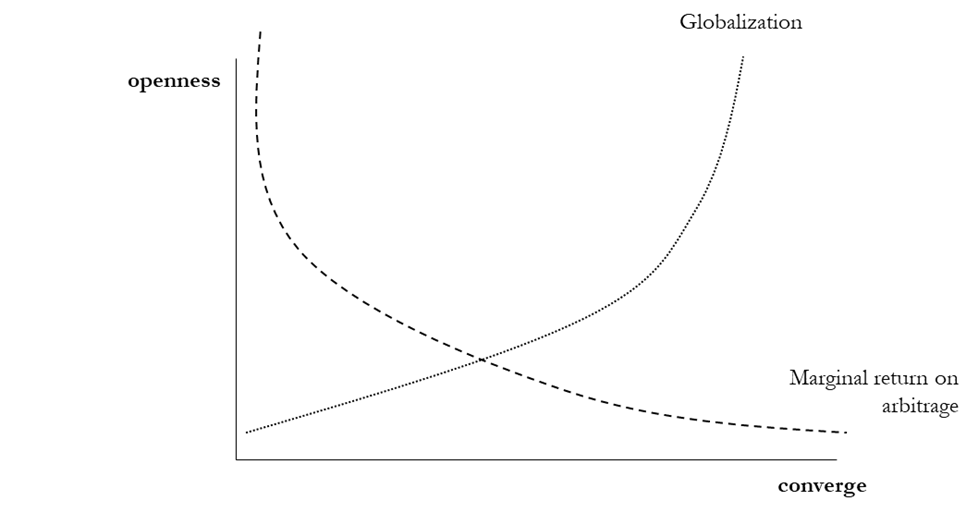
The key to this successful story, as mentioned, is the perdurance of arbitrage opportunities. The closing of the arbitrage gap compresses returns on a certain type of FDIs. Yet labour cost differentials, albeit important, are not the only source of arbitrage. Differentials in labour market institutions and- more broadly- in regulation are as important. The more important, the narrower the return on labour cost arbitrage; and the higher the standards of the stronger counterparts are. Regulatory differences are determinants of production costs in many ways, but the easiest ones to exploit pertain (1) environmental regulations, (2) labour standards, (3) tax rates. As stronger regulations and higher labour standards are likely to affect upward the costs of production, All these regulation differentials are a major source of arbitrage opportunities. When markets are open but regulations differ, the differential in regulatory standards creates a wedge in the convergence of costs, opening opportunities to relocate production activities not necessarily where labour costs are lower, but where total costs are. Instead, when regulations and standard converge, arbitrage opportunities decrease, reducing the marginal return on those FDIs that only rely on cost differentials to be profitable. Hence, the economic forces of globalization bring about slow but certain factor price convergence, and its political forces bring about regulatory and institutional convergence; both reduce over time the possibilities for arbitrage, compressing the “easy” return on capital. This is represented in figure 1: by “easy” return I mean return on capital which is not due to proprietary technical or production process progress, but merely on the efficiency gains attributable to cost differentials.
Figure 1
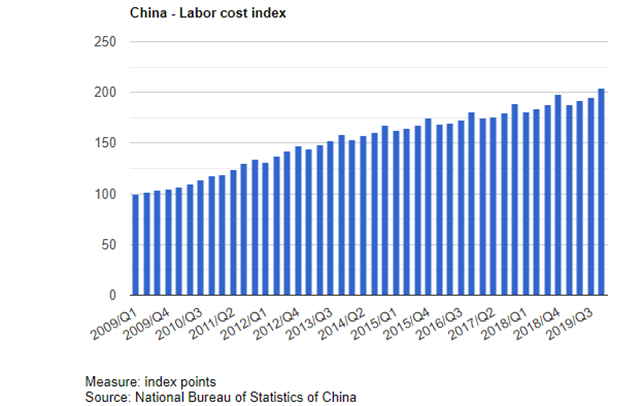
Yet the stronger counterparts have been well aware of the effect of different standards and regulations; from social dumping normative to environmental standards, the west has sought to ensure that the opening of global markets is increasingly subject to common rules. The “third way” governments of the late 1990s and early 2000s were especially keen to this global multilateral agenda; from the relaunch of the ILO to the inclusion of social and environmental principles in the WTO negotiations, from global negotiations on environment and pollution to the inclusion of environmental and product quality clauses in bilateral trade treaties, the west has sought to enshrine globalization in a web of ever closer multilateral norms, hence compressing arbitrage opportunities and routes to easy profits through simple relocations where production standards are lower. The two effects have summed up: as shown in figure 2A—if we can accept that Chinese labour prices are a good proxy for the labour costs of “new” markets—regulatory convergence accompanies a convergence in labour costs.
Figure 2A-China labour costs
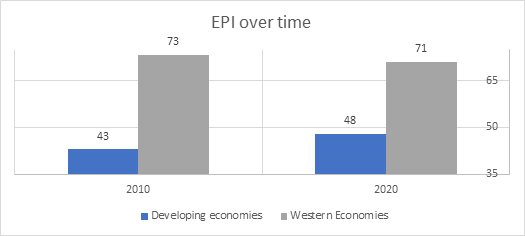
Similarly, figure 2B shows the change in the Environmental Protection Index (a composite index of environmental protection quality and regulations) built by the University of Yale and the European Commission, for two groups of representative countries in the developing and Western world. Their relative protection has converged in the past decade, decreasing the capacity of arbitrage-seeker FDIs to locate in weakly protected economies.
Figure 2B. EPI index compared
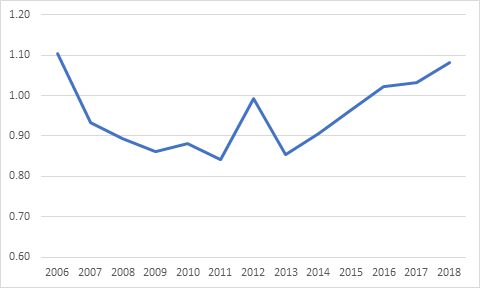
Finally, Figure 2C presents the differential (for the same group of countries) between the two groups scores for the regulatory quality index of the world bank; higher scores mean higher quality in the developed economies vis-à-vis developing ones, while lower scores indicate stronger convergence. As seen, the 2000s have seen a strong convergence in regulation quality, which has started to unfold in the second part of the 2010s.
Figure 2C: regulatory convergence
The exact same logic applies to regulation in the field of taxation, where the gains from regulatory segmentation are even more apparent: international capital mobility coupled with national taxation governance is a source of great profitability on its own, with large, mobile businesses able to exploit regulatory arbitrage, while smaller businesses struggle to do so.
In sum, globalization was leading to convergence in costs and regulations, compressing the expected profitability of those corporations relying on the easy strategy of exploiting arbitrage to ensure profitability. Granted, this is not a problem for all multinational companies: those enterprises whose added-value is cumulated through technological and process progress had little to fear by regulatory and costs convergence. But other companies had a lot to be afraid for: someone had to do something. And here, around the year 2010, enter the first populists. Boosted by the likes of news empires like Fox News (owned by Murdoch group) and the Mirror group (owned by a variety of global investment banks like JP Morgan and Barclays, and several investment funds) and spearheaded by business tycoons like Donald Trump, populists all over the western world have a common agenda: nationalist regulatory retrenchment. Few are against free markets: the spice must flow. But by ensuring that all forms of political globalization are scaled back, they make sure that cost gaps remain wide open, and therefore the laziest forms of capitalism they represent—those relying exclusively on exogenous cost differentials, rather than in human ingenuity and technological advance –maintain a hedge. Diagram 3 provides a stylized view of this process. The vertical axis depicts the degree of political globalization, while the horizontal line depicts economic globalization. The 45° line depicts a symmetric, balance advance between globalization in political and economic terms. Assuming prices will always tend to converge, and that therefore on the long term arbitrage depends on regulatory and institutional differentials, the difference between the 45° and the actual trend captures the expected long-term gains from arbitrage.
Figure 3: a stylized model of globalization-protecting populism
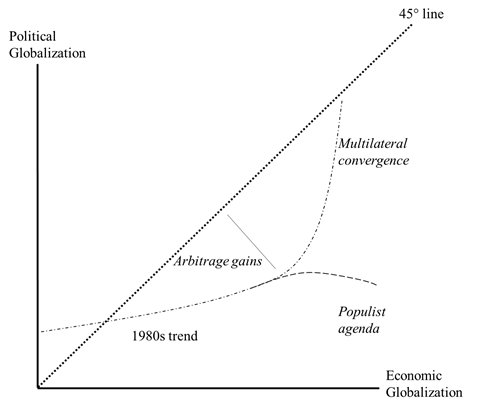
To be clear, this is a battle within capitalism itself: many businesses greatly profit from regulatory convergence, which builds cross-national trust on regulations and stabilizes business sentiment; many also greatly benefit from price convergence and the ensuing boost to consumption that increased purchasing power in the developing world entails. These businesses are often less reliant on price competitiveness, and extract profit instead from technological leadership. But for Donald Trump, Boris Johnson and their backers, ensuring that market openness is coupled with regulatory segmentation is a matter of business model survival; ensuring capital, services and goods mobility, whilst preventing tax, labour and environmental regulations to converge, is the golden egg of greedy scrooge. From this vantage, populism’s goal is not to end globalization, but to prevent the political spillover, which would ensure the narrowing of regulatory differentials and therefore the drying of profits from regulatory arbitrage. A famous theorist once maintained that economic structures determine cultural ones, and these in turn reinforce the economic structure; Mr. Murdoch probably agrees.
*cover image credit: globaltrademag