Beyond democratic deficit: modelling legitimacy and politicization
In a previous article, I discussed the fundamental issue of contemporary politics: the mismatch between "hyperglobalization" in economic integration, and "under-globalization" in political integration. This mismatch applies, especially, to the European Union. In a forthcoming book chapter I bring that discussion much further. The full book Chapter can be downloaded on ResearchGate, but here I provide a summary. In particular, while the hyperglobalization narrative is surely compelling, one may wonder whether it may be, perhaps, too linear in its explanation of the phenomenon of politicization of supranational integration.
1. Functional Legitimacy.
After all, not all policy fields are made equal: some areas (for instance, technical regulations or standards) could be integrated easily with no harm to the democratic sustainability of a political system (even in the eyes of populists or nationalists, see figure 2). Understanding legitimacy, in other words, requires both a modelling of legitimacy as such (in our case, input and output) and a modelling of different forms of public functions. Some functions (mostly regulatory) are better carried out by institutions “insulated” from the political system, in order to deliver effective regulatory policies without pressure from interest groups; while other policies (typically redistributive policies; but in this post we refer, more broadly, to "high politics") require democratic decision-making processes. This understanding of public policy is well complemented by by a conceptualization of legitimacy as “input” and “output”, whereby input legitimacy is provided (in a democratic system) by an effective electoral process, while output legitimacy is provided by successful policy making. Indeed, I suggested previously that, as long as integration concerned functions perceived as non-redistributive, output-legitimacy alone was largely sufficient, for democratic decision-making is required only on certain key fields, while regulatory policies can be dealt with in insulated institutions without harm to democracy.
This reasoning is represented in figure 1. From our definition of public functions we can assume a continuum between pure regulatory powers and redistributive functions/high politics. Also, we can assume, instead a continuum between output and input legitimacy, where input legitimacy stands for democratic governance (direct or representative) while output legitimacy stands for legitimization trough successful policy outcomes.
| Figure 1- functional-democratic legitimacy |
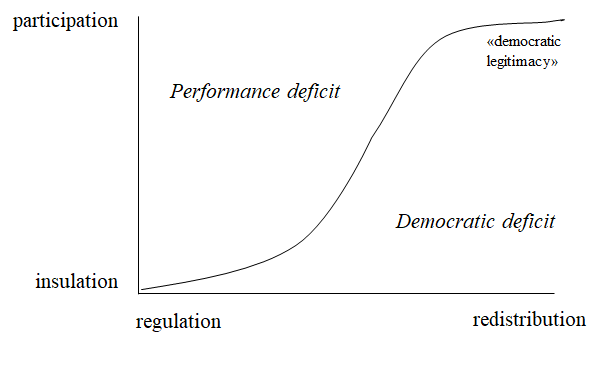 |
in other words, the nature of the function (redistributive or regulatory) determines the nature of legitimacy (input or output) required. it follows that legitimacy disequilibria may emerge: for instance, excessive participation (for example, through direct democracy instruments) to deal with functions that do not actually require it (for example, technical regulations) would do to legitimacy more harm than benefit, because they would create a clear “performance deficit” in policy fields where excesses of representation provide no legitimacy gains. Figure 1 gives a graphical representation of such system: a performance deficit is associated with a lack of output legitimacy, while a democratic deficit is associated with a lack of input legitimacy. The function in the centre of figure 1 identifies the area where policies are fully legitimated; it is assumed to be S-shaped because it is reasonable to expect that the more we move towards integration of redistributive policies (or core state powers), the more input legitimacy is needed (and the other way around). At some point, as long as we maintain that individuals do hold democratic beliefs, a need for input legitimacy will arise if an international organization acquires sufficient redistributive/ core state powers. Therefore, for this condition being satisfied, the level of democratic decision-making provided by the system must fall on the legitimacy function. If it falls below, the system suffers from some degree of democratic deficit.
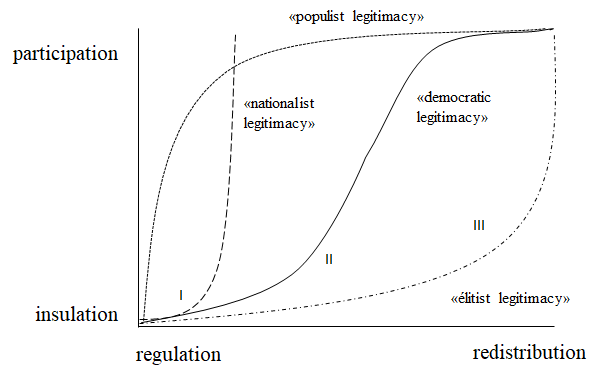
Now, it is reasonable to assume that different agents (with different identities and utility functions) have very different legitimacy functions (figure 2). For instance, genuine elitists are likely to support much more insulation than supporters of direct democracy, which would likely see no insulation at all. It is clear that the main danger for any supranational system is represented by nationalist sentiments: no matter the degree of representation/participation delivered at supranational level, nationalist legitimacy will still consider the spilling-over of high politics/redistributive functions at supranational level as a source of democratic deficit.
| Figure 2 Functional-democratic legitimacies compared |
 |
Having assessed how democratic legitimacy is provided in multilevel supranational organizations, we now analyse the specific case of the European Union. Europe has witnessed a growing rhetoric against the “unelected bureaucrats” allegedly taking decisions instead of “the people”. In other words, the spilling-over of integration (due to crisis-induced functional pressures) into high politics shifts integration “to the right” of figures 1 and 2, towards high politics and redistributive functions.
Hence, even for genuine democrats, the crisis creates a need for input legitimacy which was not there before. On figure 1, the effect of crisis-led integration corresponds to a shifting of the Union on the right side of the diagram; moving from a situation of “performance deficit” (by definition, a crisis) to a situation of democratic deficit, as a consequence of institutions and policies introduced in response to the crisis.
Democratic deficit- i.e., the lack of spaces for contestation at supranational level-produces two (democratic) counter-movements: domestic politicization and institutional politicization. Politiciziation is double because the political system of the European Union can be characterized by a politicization mismatch: while the European Union institutions deal with policies without politics, national political systems retain politics without policies, in the famous words of Vivien Schmidt. This gap provides a maneuvering space that political agents tend to narrow by politicizing European integration in both directions, by means of two politicization counter-movements.
On the one hand, politicization appears as domestic struggle to prevent the implementation of (seemingly illegitimate) EU-wide policies, at times by going as far as attempting to decrease the level of integration altogether (and bring back “the policies” at domestic level). This process is inherently constraining towards European integration, and take place mostly at national level. On the other hand, politicization appears as a drive to inject “the politics” into the supranational governance, à la fois expanding the autonomy of supranational actors by increasing their input legitimacy, and/or by loosening the constraints on their (autonomous) action; such process enables European institutions to expand their capacity of discretionary action, bringing politics at the supranational level.
In other words, the era of “constraining dissensus” should not simply be seen as a threat for Europe, but also considered as a natural phase that the Union has to go through in order to fully evolve in a complete political system; there is no democratic state that has not experienced, at some point of its formation, a centre-periphery cleavage. For a very long time, the “eternal crisis” of European integration did not push integration into highly politicized fields of “core-state” competence. However, the Euro-migration crises have surely pushed the EU to cross the line. Whether the EU will join the collection of successful (con)federations, or whether it will be remembered as an example not to follow, ultimately depends on the capacity of the EU of turning the tide of the politicization counter-movements towards being a force of integration rather than disintegration.
Two main hurdles stand on the way. First, failing to produce widespread benefits for the majority has two important side effects. On the one hand, it prevents the progressive construction of a genuine European identity (since identities and allegiances are, for the large part, endogenous to the benefits, experiences and education of individuals), thus failing to defuse the risk associated with nationalist attitudes (which, we show in figure 2 can never be associated with European integration, no matter how democratic the Union becomes). On the other hand, shortcomings on the output-side of legitimacy are deemed to raise the question of policy contestability; hence, mutatis-mutandis, any level of democratic deficit becomes more salient, and more dangerous, when output legitimacy is low. Second, maintaining integration on a pattern that reproduces an elitist vision of legitimacy (again, as represented in figure 2) can very possibly be perceived as illegitimate not only by nationalist and populist parties, but also by the large silent majorities of our democracies; this shift from “constraining dissensus” to “constraining consensus” could very well bring the European integration project to its ends. However, if the EU successfully navigates around these rocks, adapting instead to the challenges that the two politicization counter-movements analysed in this Chapter naturally generate, it may very well return to be a prime example of conciliating globalization and political action solving the Globalization mismatch and paving the way for a global community that is able to couple the benefits of globalization with the benefits of democratic rule.