Endogenous elements in the migration crisis (yes, it's another trilemma)
The migration crisis, like the Eurocrisis, is here to stay, for it "traps" EU policy makers into the contradictions of the partially functionning, partially dysfunctional system we built. Frank Schimmelfenning's paper put forward a very convincing argument on the explanation on the different outcomes of each of the two crises; his basic argument is grounded on the different institutional deepening that each of the two fields involved (EMU, Shenghen) had achieved prior to the crisis. My contribution to that debate -here outlined, and hopefully soon to be transformed into a dedicated paper - touches upon two elements that complement Frank's analysis. First, I'd like to claim that the migration crisis is yet another case of endogenous-crisis-led integration. Second, I'd like to claim (as I do since at least early 2015) that the main reason for the hardship in progressing to find a structural solution is to be found in yet another "trilemma-like" trap, where equally valued, highly conflicting goals prevent a stable solution to the crisis.
(A) is the migration crisis endogenous? - The degree that the "migration crisis" is exogenous can be heavily disputed: while it is correct that the flow generates elsewhere and mostly for reasons outside of the EU direct control, this is far from being the full story. There are overwhelming endogenous factors that determine the choice of the EU (and, perhaps, the decision to move as such). These factors all depend on the mismatch between the (mostly national) migration policy and border responsibilities, and the integrated Shenghen area. Without such a mismatch, the incentive to move would have been much lower. Let's analyse these mismatches:
(1) the importance of national policy: this is the most straightforward endogenous cause of the crisis; the famous "refugees welcome" speech by Angela Merkel, largely uncoordinated with the partners, was a substantial pull factor. With a common migration policy, this would have not happened (or it would have unfolded in a very different way).
(2) the absence of a serious joint border control: while the mobility is mostly ensured through the Shenghen area, there was not such a thing like a serious joint border control. Each country (was) responsible for setting up and finance its border controls, regardless of its economic situation, geographical position, and incentives. In some cases, the economic situation was so dire that very few resources could be devoted to the task; In others, the geographical position made it the natural starting point of migration through Europe; in other cases, there were little incentives to discourage outward mobility and Shenghen abuse in order to minimize long term costs. In some countries, such as Greece, the three factors happened simultaneously. Mutatis Mutandis (and apologies for comparing humans to goods, although only for exemplifying purposes) the Shenghen area without joint border control is like a common market without custom unions: it won't work.
(3) in the absence of a mechanism to redistribute migrants both to more attractive and less attractive areas, the sheer size of a migration flow can induce some sort of unilateral suspension of the Dublin regulation principle of "Aylum demand in the first country reached". Any country will have a threeshold of migration beyond which it cannot cope any longer with the flow, hence letting people spillover into the broader Shenghen area. It's just a matter of setting the stage for a sufficiently larger attack; Mutatis Mutandis once again, an "incomplete mobility area" is as much as vulnerable to adequately staged migration flows, as an incomplete monetary union is vulnerable to adequately sized speculative attacks.
in sum, my preliminary view (which I hope data will corroborate once they are collected, although one never knows) is that the Migration crisis is indeed a classical form of functional crisis, where the dysfunctional elements of integration (i.e., the mismatch between integrated policies and the residual national competences) transform an otherwise manageable situation into a crisis that cannot be addressed without removing those dysfunctionalities (hence, the competences mismatch) in one direction or the other. In other words, it's a case of an exogenous shock evolving into an endogenous crisis because it impacts on dysfunctional institutions.
(B) the Migration Trilemma - Yet, if the situation were that simple, we would have solved the crisis yet. Why then not so? Surely, it's because of "national sovereignty" as some would claim; however, national sovereignty can't become a catchword to identify all shortcomings of the EU construct. My view is that here, once again, we assist at a clash between structurally different views of what national sovereignty is, and what priorities it entails, in other words, yet another policy trilemma.
If you follow this website, read my papers and/or have you got into the unpleasant business of talking economics with me, you are surely familiar with my infatuation with trilemmas. This one is rather old: it was developed in April 2015, when the migration crisis was in its early stages. Back then, the European countries were stuck in a series of crossed vetoes: all wanted to decrease down to zero the absurd casualties from the Mediterranean migration flows, preventing the Lampedusa Straights from becoming a "Sea mass-grave". However, there was (back then) no willingness to develop a serious common migration policy, either in the form of joint border guards, nor in the form of redistributing asylum seekers. And furthermore, there was no willingness to have "boots on the ground" in Lbyia either, to prevent people from leaving through a closer control of the Lybian coast itself. Needless to say, these 3 stances are contradicting each other and qualify a trilemma: one of the "vetoes" shall go.
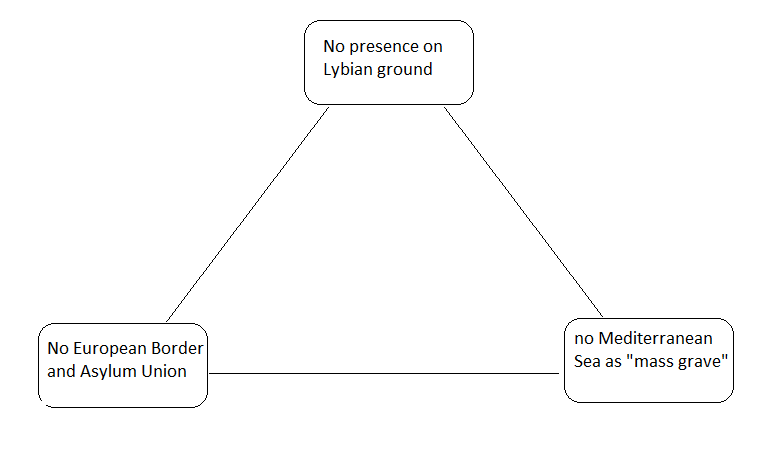
Now, since the trilemma was conceived, the EU made substantial efforts in the direction of a "border and Asylum union" (not the official name of that patchwork of deals, regulations and directives, but it gives substance to it and a label); including the reinforcement of border controls and the redistribution of some migrants. Both measures, however, have been proved rather ineffective; the former for it only concerns "ad-hoc" border areas, protected with "ad-hoc" border missions; hence, the smugglelords that control the flows can easily set up alternative routes to avoid the new guards. A stable solution would require, hence, a comprehensive pre-deployed EU border guard- a step into political integration many countries are unwilling to take. The second pillar of the Border&Asylum Union has not achieved greater success: not only the policies redistributing migrants across EU countries has unleashed a wave of fresh anti-EU, nationalistic-grounded populism, but also it has achieved very little even in the countries that have accepted it without complaints; the total number of relocated refugees is in the lower thousand in 2 years, while the total immigration flow is counted in hundred of thousand per year. In sum, the "integrationist" solution was attempted; its building-blocks set in place; but all in all it failed to deliver due to the losses of national autonomy that those proposals entailed if they were fully taken on-board. While the infrastructure remains in place, hopefully creating the conditions for further integration in the future building on already established institutions, the EU leaders have since then started to look for alternative solutions. Finally it was the French President Macron (with the support of the italian Minister of Interiors) who proposed to switch grand strategy and let the EU diplomatic service start a series of hotspots on the Libyan ground. Indeed, wile such a move would seem just a marginal improvement over previous policies, in fact it really represents the third vertex of the trilemma I had proposed back in 2015. If the solution is introduced coherently, it prevents to put excessive pressure on the currently understaffed, not-performing Border & Asylum Union, while avoiding to let Mediterranean to become again a sea mass-grave. One should be aware, however, that - excluding truly Neo-colonial projects- such a project cannot constitute a long term solution to a union institutionally unprepared to deal with the attraction force it still constitutes, somehow at a great surprise of its own citizens.