Europe's circular illness
Last week was disappointing for European cooperation and decision-making. A Dutch “majority” of 2.4 million people voted against the EU’s Association Agreement with Ukraine – an agreement between 29 elected governments might be blocked. Although it is still uncertain how the referendum’s result will affect the Dutch government’s ratification, the referendum brought a major European problem to the surface: its vicious circle of indecisiveness.
In fact, the referendum was not about strengthening ties with Ukraine. Instead, the result reflects the Dutch reluctance to delegate power to Brussels. This phenomenon is of course not limited to the Dutch society, since Euroscepticism is present in every member state. I argue that this Euroscepticism reinforces itself and enhances a decisional impasse in Europe, which I represent by a vicious circle.
The vicious circle
An important starting point is that countries face international problems nowadays, which they cannot solve by themselves. Since carbon emissions, refugees and terrorists do not stop at national borders, international solutions are required for these border-crossing issues.
1) No strong centralized decision making
However, the European institutions are designed such that individual member states can block decisions on major issues. The important decisions are made in the European Council and require unanimity. When a European solution hurts the domestic position in some way, politicians withdraw from the proposed measures, even when this makes the required international solution impossible or when it worsens the problem.
As a result, domestic interest groups are able to affect European political output. National monopolists, elites and lobbyists, who have self-interested preferences, can influence a minister’s veto. This hinders European decisions on international issues, since there are always parties favoring the status quo.
2) Weak response to international issues
This setup limits the way Europe deals with challenges. The measures are often too late, artificial compromises, minor changes, or outcomes of horse trading: everything that was able to pass 28 domestic electoral filters. Instead of vision, effectiveness and efficiency based solutions, the current institutional setting favors temporary measures and political stagnation.
Examples can be found in many fields. From the difficulties Europe has to establish a unitary European patent, till the excessive prices for roaming abroad. Europe also struggles already for three years to find a real solution for the refugee crisis. Coordinated measures are almost impossible due to the 28 migration policies.
3) People observe lacking EU output
People observe that the European Union is not able to deal with the issues it faces. People read in newspapers that problems linger or get worse, whereas real solutions stay absent. This decreases people’s confidence in incumbent EU leaders and foreign politicians.
People see that Brussels and Frankfurt are not able to facilitate economic recovery after the financial turmoil. Instead, people see that their tax funds are wasted by moving the European Parliament between Brussels and Strasbourg once a month (France will veto a proposal to leave Strasbourg as parliamentary meeting place).
4) People refuse to delegate power to Brussels
Since people see Europe’s inefficiencies and lacking output, delegation to Brussels is neglected. Why would populations delegate more power to a political entity with limited results? The anti-European pressures within member states retain national politicians from “thinking European”. The power of anti-European politicians is increasing which makes delegation more and more unlikely.
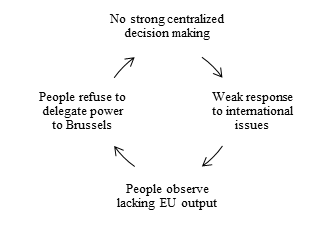
Here we completed the circle. Brussels fails to deal with ongoing issues since it does not have the power, while people do not want to delegate power, since they see that Brussels cannot deal with issues.
The obvious question is how to escape this circle. Although people must be aware that their domestic power grab worsens the situation, we cannot expect from people to set aside national thinking. Instead, change should origin from political leaders, either on the national or European level.
Europe needs politicians who understand that border-crossing challenges cannot be solved in isolation, leaders who dare to take unpopular but essential decisions and leaders who really want to solve problems, rather than serving interest groups. These politicians must abandon the veto system in the European Council and transfer more power to the European Commission. An enhanced role for the European Parliament preserves democratic control. We cannot expect Brussels to solve international problems, without giving them the means.
Sebastiaan Wijsman sebastiaan.wijsman@kuleuven.be